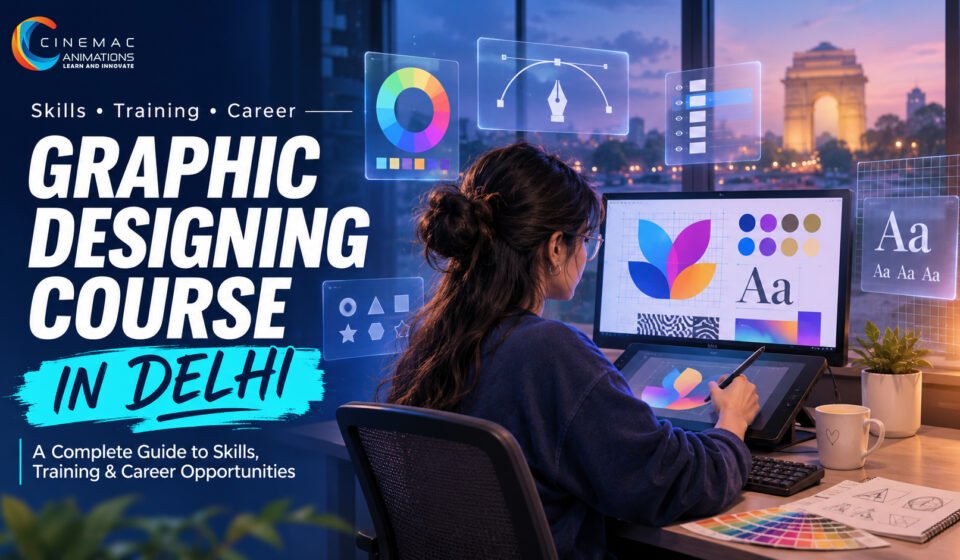
Graphic Designing Course in Delhi: Skills, Fees & Career Opportunities

Ever come across a stunning Instagram post, an appealing logo, or some attractive packaging and thought to yourself, “Who comes up with this stuff?” The answer is graphic designer!
Graphic design is the process of transforming imaginative ideas into visual representations. Graphic designing is required today for almost every business to sell its products and services and also to create a good brand image.
Graphic designers are present in every aspect, whether it be social media designs or web designs, logos or marketing campaigns.
If you are creative by nature and would like to make a career out of it, graphic designing might just be right for you. And the great part is, you do not need to be a talented artist or some technical genius.
In this guide, we talk about everything that one must know about graphic design courses in Delhi in 2026.
What Is Graphic Designing and Why Is It Important?
Graphic designing uses visual elements to communicate messages. A graphic designer will take an idea and put it into a design which makes it easier to understand and remember.
For example when a brand launches a product it needs a logo, packaging, social media ads and promotional banners. That’s where a graphic designer steps in. They create visuals that capture attention and build brand identity.
This type of design is used in various industries including:
- Advertising and digital marketing
- E-commerce
- Media and entertainment
- Fashion and lifestyle
- Education and publishing
- Corporate branding
More and more businesses are moving online every year. That means the demand for design is growing fast. Whether it’s a startup or a big company they all need visuals that work.
That’s why learning design is not just fun—it’s also a practical choice for the future.
Graphic Designing Course Duration, Fees and Eligibility in Delhi
One common question students ask is how much time and money they need to learn graphic designing.
The answer depends on the type of programme you choose.
| Course Type | Typical Duration | Fees Structure |
|---|---|---|
| Basic Certificate Course | 2 to 4 months | ₹10,000 – ₹30,000 |
| Professional Graphic Design Course | 4 to 8 months | ₹25,000 – ₹80,000 |
| Advanced Diploma | 8 to 12 months | ₹50,000 – ₹1,50,000 |
| Bachelor's Degree | 3 to 4 years | ₹3,00,000 – ₹8,00,000 |
The eligibility requirements are generally flexible for short-term professional courses. Students from arts, commerce and science backgrounds can learn graphic designing.
Even beginners, with no design experience, can start with the basics.
What Will You Learn in a Graphic Designing Course?
A good graphic designing course should teach more than just how to operate software. It should help you understand the thinking behind a good design.
Here are some important topics you should look for in a course:
Design Fundamentals
Learn colour theory, typography, layout, shapes, balance and the essential principles of visual communication. Understand how to create professional designs that communicate ideas effectively.
Adobe Photoshop
Master photo editing, image manipulation, digital art and social media creatives. Learn background removal, image retouching, creative compositions and professional photo editing techniques.
Adobe Illustrator
Explore logo design, icons, illustrations and vector graphics. Create scalable artwork and develop creative branding elements without losing image quality.
CorelDRAW & Adobe InDesign
Learn professional print design for banners, brochures, visiting cards, magazines, catalogues, books and multi-page documents.
Practical Projects
Apply your creative skills through real-world projects such as business logos, product advertisements, posters, brochures, packaging designs and social media campaigns.
How to Choose the Best Graphic Designing Institute in Delhi
Choosing an institute is a big decision. Don’t go for a course simply because it’s in the advert or because it’s cheap.
Before taking admission, consider these points:
- Experienced trainers: Do trainers have practical industry knowledge?
- Curriculum: make sure the program teaches the required design software and AI tools;
- Practice: do the learners do any real practical works;
- Portfolio: check that you will get a professional portfolio by studying at the institute;
- Placement Service: find out what program is used for finding internship and job;
- Demo Classes: you may participate in a demonstration class to see how tutors teach;
- Student reviews: do check if the previous students found the course useful and see what projects they completed.
An effective institute should be one that allows you to gain confidence in designing independently, rather than just teaching you which buttons to press within different software applications.
Graphic Designing and AI Tools in 2026
Graphic designing is changing with the introduction of intelligence. Today designers can use AI tools to generate ideas, remove objects, create image variations and speed up repetitive tasks.
Some useful tools include:
- Adobe Firefly for AI-assisted image creation and editing.
- Canva for designs and social media creatives.
- Photoshop Generative Fill for image editing.
- Illustrator, for vector artwork and illustrations.
However, remember one thing. AI tools cannot replace your understanding of design fundamentals, creativity and visual communication. A good designer knows how to use technology to improve their work by depending on it completely. That is why choosing a course that includes both design skills and modern AI-assisted workflows can be valuable
Career Opportunities After Completing a Graphic Designing Course
After finishing your training and making a portfolio you can look for different career options.
Some popular job roles include:
- Graphic Designer: Produces posters, banners, ads and all sorts of digital creatives.
- Logo Designer: Creates identities and the associated branding for a business.
- Social Media Designer: Creates the posts, stories, thumbnails and promotional designs.
- Brand Identity Designer: Logos, colours, typography and the full brand guidelines.
- Packaging Designer: Designs the labels, boxes and packaging.
- Freelance Designer: Works for clients and businesses on their own.
Your salary will be determined by your skills, your portfolio, your experience, where you are based and the company you work for. A novice will generally be looking at entry level work, whereas a more experienced designer will be looking at paid work and possibly working independently.
Why Is a Portfolio Important for Graphic Designers?
Imagine two students applying for the same graphic design job.
One student has completed a course and received a certificate. The other has completed a course and can also show 10 to 15 impressive design projects.
Who do you think has a better chance of getting noticed?
In most creative hiring situations, a strong portfolio can make a big difference.
The portfolio should contain a variety of works, such as:
- logos and identifying designs
- web promotions
- product packing
- Posters and brochures
- Photo editing and creative compositions.
Try to explain the rationale behind each project. That way the employer will get a sense of your design thinking as well as what you actually produced.
Frequently Asked Questions
Everything you need to know about graphic designing courses, skills, training and career opportunities.